BRief Intervention and Treatment for Elders
Funded by the SAMHSA/Center for
Substance Abuse Treatment SBIRT Initiative (2006-2011)
The mission of the Florida BRITE Project was to
serve individuals 55 years and older to identify non-dependent substance use or
prescription medication issues and to provide effective service strategies
prior to their need for more extensive or specialized substance abuse
treatment. BRITE implemented the Screening, Brief Intervention,
and Referral to Treatment (SBIRT) initiative of the
SAMHSA Center for Substance Abuse Treatment (CSAT). BRITE was the only project funded by an SBIRT
grant to specifically focus on an older adult population.
History: The Pilot
Project
The SAMHSA/CSAT grant
award was built on the success of a three-year pilot
project from 2004-2007 funded by the Florida Department
of Children and Families Substance Abuse Program Office (DCF/SAPO) and
conducted in four Florida counties. Provider agencies offered in-home
screenings and services, focusing on brief intervention for alcohol, illicit
substances, and prescription and over-the-counter medications. Results
published in the American Journal of Public Health
(Schonfeld et al. 2010) describe 3,497 screenings,
demonstrating statistically significant reductions in use of alcohol, medications,
and illicit drugs, as well as reduced symptoms of depression.
In late 2006, Florida was awarded a $14 million CSAT grant to focus on providing services within primary and emergency health care settings, public health clinics, elder homes, and aging services. Dr. Robert Hazlett, who had previously worked on Pennsylvania’s SBIRT project developed the protocols that allowed BRITE to shift from a pilot project to the requirements for the federal grant.
In the SBIRT grant, BRITE clients were served by one of four categories of
service providers receiving contracts from DCF:
healthcare providers (urgent care centers, trauma hospitals, emergency departments,
and VA facilities), aging services, mental health services, and substance abuse
treatment services. Over the five year grant, a total of 30 provider agencies
in 18 counties conducted 85,001 screenings in over 70 different locations.
Also, in 2010, under separate funding from the Florida Department of Children
and Families, BRITE services were expanded to include adults under age 55 at
federally qualified health centers (FQHCs) in Orlando, Ft. Lauderdale, and
Pensacola, resulting in an additional 6,000 screenings. Although the grant
ended on September 14, 2011, several sites have continued to implement a
modified version of the SBIRT model. Published results from the five-year SBIRT
grant are available at:
Locations
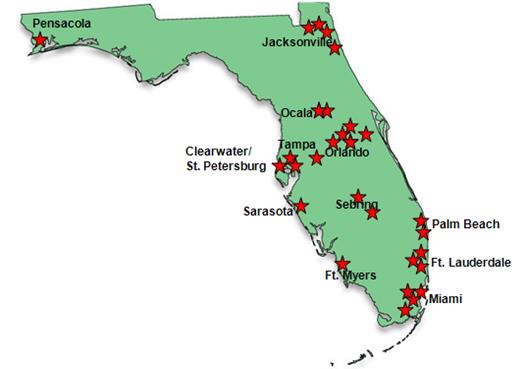
The Florida BRITE Project provider agencies
were headquartered in the sites represented by the red stars in the map below.
Cumulatively, these agencies screened in more than 70 different locations
including hospitals, urgent care centers, trauma centers, aging services,
health fairs, and numerous other locations.
BRITE Sites included:
Lakeview Center, Inc. Baptist Hospital
Emergency Room, Pensacola
Urban
Jacksonville/Shands Jacksonville Medical Center - Level I Trauma Center
Urban Jacksonville Aging Services
Shands
Jacksonville Level 1 Trauma Center
Shands
Ambulatory Care Center
Lake Regional
Urgent Care - Leesburg
Lake Regional Urgent Care – The Villages
The Center For Drug Free Living Inc. (Orange County, Osceola County)
Aloma
Urgent Care
Clermont Walk-In Clinic
Longwood
Walk-In Clinic
Florida Hospital Heartland Division Sebring –
Emergency Department
Florida Hospital Heartland - Lake Placid
Winter Haven Hospital
Jackson Memorial Hospital (Miami)
Jackson North Community Mental Health Center
(Miami)
Catholic Charities
of the Archdiocese of Miami
Miami Veterans Health Care System - Bruce W. Carter VA Medical Center
Coastal Behavioral Healthcare, Inc.
(Sarasota area)
Gulf Coast Jewish Family Services
Centre for Women
Drug Abuse Comprehensive Coordinating Office, Inc.
Palm Beach County Division of Senior Services
Hanley Center- Lakeside Hospital (West Palm Beach)
Broward County Elderly and Veterans Services
Division (2 sites)
Broward County VA Outpatient Center (Miami VA
Healthcare System)
Southwest Florida Addiction Services
The
Required CSAT GPRA Instruments: https://www.samhsa.gov/grants/gpra-measurement-tools/csat-gpra
In
addition to the GPRA instrument, the Florida BRITE Project collected
prescreening, screening, and assessment data and offered educational materials
developed by Dr. Hazlett. These are as follows.
----------------------------------------
Procedures
for Initiating and Sustaining the Florida BRITE Project
Authored
by Robert W.
Hazlett, Ph.D, CAC, CCS
Florida BRITE Project “Business Process Analysis” – This is a guide for BRITE providers to use to obtain
information about a clinic or hospital unit’s operating routine. It guides the
BRITE team’s effort to design a protocol to implement BRITE in a specific
setting, while being sensitive to the workflow and logistical support issues of
that particular setting.
Florida
BRITE Project “Initial Training Manual” – this manual provides
training to site personnel for screening of potential substance use, abuse and
dependence disorders in a hospital, primary care or clinic setting and how to
apply brief intervention strategies matched to the patient’s severity of
use/abuse of alcohol and other drugs (AOD).
Florida BRITE Project “Sustainability Manual” – This is a guide to
understanding what is involved in the process of developing a sustainability
plan for SBIRT services even after federal grant funding ends. It is a
framework that allows for flexibility and change in your agency’s local
environment, and that considers elements that may impact that environment.
Assessment
Instruments and Educational Materials for BRITE
Some materials are in
the public domain and available from CSAT and other instruments were developed
for BRITE by Dr. Robert Hazlett.
Screening Instruments
- BRITE Prescreening Instrument –
NOTE: You are required to complete the demographics section of GPRA Screen
Part A as well
- Short Geriatric Depression Scale
(S-GDS) – Administer if the person responds “YES” to either of the two
prescreening items on depression.
- GPRA Screen Part A – Demographics
only:
- BRITE Screening GPRA – Part A (English) = Page 2 of
GPRA (demographics)
- BRITE Screening GPRA – Part A (Spanish) = Page 2 of
GPRA (demographics)
- Required
instruments available from CSAT or the World Health Organization (WHO0 - Florida BRITE Providers may download the
following items from either the respective websites:
- ASSIST - Screening Instrument (English) - WHO
- ASSIST - Screening Instrument (Spanish)
- WHO
- GPRA Assessment – visit SAMHSA/CSAT website
Educational Materials
- Handouts to be distributed to
professionals and clients of the BRITE Project are available in both
English and Spanish.
- Crack and Cocaine (English)
- Crack and Cocaine (Spanish)
- Methamphetamine (English)
- Methamphetamine (Spanish)
- Stimulants (English)
- Stimulants (Spanish)
- Curricula
- Brief Intervention:
1.
BRITE Health Promotion Workbook (English)
2.
BRITE Health Promotion Workbook (Spanish)
3.
Brief Intervention for Problematic Use: Guidelines for Use in Primary Care (from World Health
Organization)
- Brief Treatment:
Substance
Abuse Relapse Prevention for Older Adults (from SAMHA/CSAT 2005).
- Supplemental Materials for Brief
Intervention and Brief Treatment
- How to Prevent Alcohol-Related Problems (English)
- How to Prevent Alcohol-Related Problems (Spanish)
- All Purpose Coping Plan (English)
- All Purpose Coping Plan (Spanish)
- AOD Refusal Skills Homework (English)
- AOD Refusal Skills Homework (Spanish)
- Coping Tool for Homework (English)
- Coping Tool for Homework (Spanish)
- Functional Analysis(English)
- Functional Analysis (Spanish)
- Short-Term Goal Work Sheet (English)
- Short-Term Goal Work Sheet (Spanish)
- Long-Term Goal Work Sheet (English)
- Long-Term Goal Work Sheet (Spanish)
- Managing Availability Homework (English)
- Managing Availability Homework (Spanish)
- Reminder Sheet for Problem Solving (English)
- Reminder Sheet for Problem Solving (Spanish)
- Risk Reduction Worksheet (English)
- Risk Reduction Worksheet (Spanish)
- Seemingly Irrelevant Decisions Tool (English)
- Seemingly Irrelevant Decisions Tool (Spanish)
- Support Plan (English)
- Support Plan (Spanish)
In the News:
Information about the
OLDER AMERICANS BEHAVIORAL HEALTH
Issue Brief: Series Overview - The Substance
Abuse and Mental Health Services Administration (SAMHSA) and U.S.
Administration on Aging (AoA) partnered to develop this 2012 Issue Brief to
address behavioral health issues for older Americans. SAMHSA and AoA included BRITE in its
listing of evidence-based and evidence-informed programs and practices for
older adult behavioral health. These programs have been scientifically studied
and have been shown to improve the health and functioning of older adults.
For
information about BRITE, please contact:
Larry Schonfeld,
Ph.D.,
Professor Emeritus, Dept. of Mental Health Law & Policy, Florida Mental
Health Institute, University of South Florida, Tampa, FL 33612 email: schonfel @usf.
edu